I really like the idea of illustrating the adventures of Sherlock Holmes, but as I have just started the project I want to look at other stories of London before I make my decision.
Mind Map
I carried out some brief research on the stories of London, looking at both historical and fictional tales. The brief is quite vague on whether or not the stories will have to surround a certain tourist attraction (e.g. the Big Ben) or if it’s just going to be set in London. This gives me a bit more freedom!
This mindmap has shown me how little I actually know about the stories of London, so I'll be doing some more research on the internet and see if I could get my hands on some books as well.
Chosen Collection of London Stories
After much thought, I am now undecided on whether to base my illustration on the Adventures of Sherlock Holmes. When I looked back at the stories I realised that many of his cases were carried out in his room on 221B Baker Street, or in unnamed places and the countryside.
This led me to the decision of looking at books on London Lore and historical stories, which I found through books such as “London Folk Tales” by Helen East and “London's Strangest Tales” by Tom Quinn.
Whilst reading these two books I wrote down notes on the stories that I deemed most interesting and useful for my illustration, so I have taken these little notes and constructed them into bullet points below.
“London Folk Tales” by Helen East
Alba to Brutus
Covers the very beginnings of London – Britain was ruled by the giant Gogmagog, son of Alba
Brutus – grandson of Aeneas, soldier of Troy. Brought a talisman with him to this strange country (a stone of Troy's wall) – this stone was then placed in centre of London and all roads lead to it
Corineas – travelling companion of Brutus. Won the battle against the giant Gogmagog by throwing him over a cliff's edge, and Cornwall was named after him
After the battle – Brutus settled by a large river – later became London – formed two guardians at each end of London – Corineas and Gogmagog
Blind Beggar's Daughter
Extremely beautiful – always helped father to beg on the streets. Dad then purchased a dog to help him out so that daughter could travel to find work in a Tavern
Men begged to have her hand in marriage but all turned away when she said they had to get permission from her beggar father – only the knight stayed and said he wanted to marry her for her, not for her money
Knight's family not happy – went to see the beggar – beggar said he will give the knight a dowry from his beggar “winnings” - all the friends of the knight then threw a shower of coins that the beggar could then pick up – he gave this to the knight.
Blind Beggar's Pub on Whitechapel road
Monday, 2 December 2013
APP Home (AOI): Association of Illustrators and Transport for London
Although my illustration would be aimed at tourists and lovers of London, the hosts will also be included in that target audience so it's important that I aim to appeal to them as well. In order to figure out what they're looking for I've decided to take a look at each company and analyse them.
Association of Illustrators - http://www.theaoi.com/index.php
The Association of Illustrators was established in 1973 to help promote illustration as a profession, offering memberships to students, colleges, freelance illustrators and agents so that they could help support them through every step of their career. This membership includes giving advice on pricing, developing portfolios, as well as providing a range of online tutorials and resources.
Even those without a membership could have some sort of access to this information by purchasing their publications such as “The Publication Directory” and “The Illustrators Guide to Law and Business” which gives advice on licensing, figuring out costs and copyright.
They are also perhaps the only company that launches international competitions – including their Illustration Awards – that celebrates the work of new graduates and professional illustrators. It was this competition that really caught my eye as I visited one of their exhibitions and was really inspired by the work displayed there: especially because one of the winners happened to be fresh-out-of-university!
Here are some of the illustrators that I found inspiring while I was flicking through AOI's portfolio:
Image sources: Anne-Marie Perks http://www.theaoi.com/portfolios/index.php/artist-details?memberid=989; Alice Wood www.alicewood.co.uk; Chris King http://www.chriskingillustration.com/; Andy Council http://www.andycouncil.co.uk/; Joe Wilson http://www.joe-wilson.com/; Tomislav Tomic http://www.theaoi.com/portfolios/index.php/artist-details?memberid=342
Conclusion:
After having a look at the portfolios advertised on their website, it seems that AOI embraces all mediums and helps promote illustrators that use different mediums. For example, there are some digital illustrations and traditional illustrations, as well as editorial and children book illustrations...
Due to the varied portfolios displayed I feel a lot more comfortable working within my own media (watercolour and ink) although I am intrigued to try out doing things digitally.
Transport for London - http://www.tfl.gov.uk/
Transport for London covers all aspects of travel; providing maps for the tube, DLR, bus, cycling, tram, overground and national rail, the river as well as providing a visitor's guide for tourists. Their site covers a wide range of information so that you could find anything you want to in terms of travelling around London.
It is safe to say that the Transport of London includes everything and anything you need to know about London. Even though they don't have an About page as such it's quite obvious what their aim is; to make your life easier when travelling. They are linked in to live travel news in case there are any disruptions on the services.
Association of Illustrators - Serco Prize for Illustration 2014
The Brief
For one of my other APP projects – as I want to prepare three just in case I go with Option B for my dissertation – I wanted to enter the AOI competition that involves illustrating a London story. Here’s the brief listed on their website (http://www.theaoi.com/events/index.php):
“London Transport Museum, in partnership with the Association of Illustrators (AOI), is delighted to announce that submissions are now welcome for the Serco Prize for Illustration 2014. This year the theme is London Stories.
Across the ages, London has produced and inspired countless stories. Fictitious or real characters and events in this amazing city have always held fascination, from the anecdotal urban myth to grand tales of historic legend. The aim of the competition is to attract artwork for display that is colourful, inspiring and celebrates a vibrant, multi-layered London.
Visually capture a well-known or lesser known narrative in a single image; all stories, current or historical, real or fictional, which feature this amazing city are welcome - your imagination is the limit. Stories could be those seen in a film or play, heard in poetry or music, read in literature or an urban myth. Impress the jury with your illustrated interpretation of a London story and be in with a chance
of having your work displayed at the famous London Transport Museum and winning the top prize.
Prizes will be awarded in three levels:
First prize: £2000 and display of image on a LTM poster
Second prize: £1000
Third prize: £750
There is also the possibility that your shortlisted image will be featured on merchandise sold in the museum shop.
The competition is open to illustrators and students of illustration throughout the world. The top 50 entries selected by a panel of judges will be displayed in an exhibition at London Transport Museum that will open Friday 14 February and run until Sunday 6 April. The winners will be announced at a private award ceremony on the evening of Thursday 13 February.
The deadline for entries is Sunday 3 November 2013.”
Analysis
Background Information
The two hosts of this competition are the London Transport Museum ad AOI (Association of Illustrators). Even though this illustration will be able a London story, it would probably be a good idea if I manage to incorporate the hosts’ work in it. For example, I could include a model of a train to represent the London Transport Museum in a very subtle way.
After taking a look at the submission requirements I noticed that the London stories they would want included would have to have an influence in modern day life – current events, history or fiction. My original idea of doing something with Sherlock Holmes might be fitting for this competition but I’d like to look into other stories as well. Looking at these requirements also confirmed my idea of incorporating some form of transport into it.
Breaking The Brief Down
This brief can cover a variety of London stories but the first one that popped into mind is the Adventures of Sherlock Holmes by Arthur Conan Doyle. However I would like to read some of the other stories of London, as I want to experiment with different styles.
To break it down into smaller points:
• The “hosts” – Association of Illustrators and London Transport Museum
Some of the modes of transport that I could include in this illustration are the Red Bus, London Underground, DLR (Serco), London Overground, Taxi (black), Tramlink, and Barclays Cycle Hire. I could also include walking or going by river.
• Collection of London stories – well-known or lesser-known, could be unusual
• Narrative in a single image
I’ve noticed that in their terms and conditions they wrote that I could do a collection of stories rather than a story, which would give me more of a leeway on portraying the whole of London. I could also have a look at communities within London as well as historical aspects, cultures and characters there. So I could quite possibly slip in Sherlock Holmes there!
• Dimensions - Portrait - Double Royal – 635 x 1016mm (25 x 40 inches) or Double Crown – 505 x 760mm (20 x 30 inches).
I underestimated the size of this poster, and it isn’t I went to see how big that was in A size did I realise that it’s huge. This might be a problem for me when it comes to designing, as I tend to work on A4 traditional media… I suppose I could dabble in digital, or see if I could work on a maximum of A3 and scan it at a high dpi.
To solve this problem I’d need to see how other illustrators who perhaps work in traditional media manage to get a really high resolution so that they could work on posters.
However for my portfolio and university submission I shall create a poster at A3 size, and produce a mock up of the larger sizes so that people could see what it would look like when hung.
• People – must show a multicultural society
If I were to portray any people within this illustration that I need to make sure that I’m showing London as a place of diversity, and that people of all cultures live or visit there.
• Needs to be colourful, inspirational, and shows a vibrant multi-layered London
• Deadline – Sunday 3rd November 2013
Conclusion:
As this competition brief mainly focuses on illustration I need to make sure I do as many experiments with media as possible, in order to broaden my knowledge of painting and I should also try out digital painting and trying out vectors (which I know that I do need to practice with more). I have recently obtained a Wacom Inkling that I could experiment with.
Even though this brief doesn’t ‘belong’ to the university I would still need to follow the learning outcomes for the APP, as I am going to do that for one of my themes. I would need to make sure that I do thorough research of the London stories and make sure that they’re from reliable resources.
For one of my other APP projects – as I want to prepare three just in case I go with Option B for my dissertation – I wanted to enter the AOI competition that involves illustrating a London story. Here’s the brief listed on their website (http://www.theaoi.com/events/index.php):
“London Transport Museum, in partnership with the Association of Illustrators (AOI), is delighted to announce that submissions are now welcome for the Serco Prize for Illustration 2014. This year the theme is London Stories.
Across the ages, London has produced and inspired countless stories. Fictitious or real characters and events in this amazing city have always held fascination, from the anecdotal urban myth to grand tales of historic legend. The aim of the competition is to attract artwork for display that is colourful, inspiring and celebrates a vibrant, multi-layered London.
Visually capture a well-known or lesser known narrative in a single image; all stories, current or historical, real or fictional, which feature this amazing city are welcome - your imagination is the limit. Stories could be those seen in a film or play, heard in poetry or music, read in literature or an urban myth. Impress the jury with your illustrated interpretation of a London story and be in with a chance
of having your work displayed at the famous London Transport Museum and winning the top prize.
Prizes will be awarded in three levels:
First prize: £2000 and display of image on a LTM poster
Second prize: £1000
Third prize: £750
There is also the possibility that your shortlisted image will be featured on merchandise sold in the museum shop.
The competition is open to illustrators and students of illustration throughout the world. The top 50 entries selected by a panel of judges will be displayed in an exhibition at London Transport Museum that will open Friday 14 February and run until Sunday 6 April. The winners will be announced at a private award ceremony on the evening of Thursday 13 February.
The deadline for entries is Sunday 3 November 2013.”
Analysis
Background Information
The two hosts of this competition are the London Transport Museum ad AOI (Association of Illustrators). Even though this illustration will be able a London story, it would probably be a good idea if I manage to incorporate the hosts’ work in it. For example, I could include a model of a train to represent the London Transport Museum in a very subtle way.
After taking a look at the submission requirements I noticed that the London stories they would want included would have to have an influence in modern day life – current events, history or fiction. My original idea of doing something with Sherlock Holmes might be fitting for this competition but I’d like to look into other stories as well. Looking at these requirements also confirmed my idea of incorporating some form of transport into it.
Breaking The Brief Down
This brief can cover a variety of London stories but the first one that popped into mind is the Adventures of Sherlock Holmes by Arthur Conan Doyle. However I would like to read some of the other stories of London, as I want to experiment with different styles.
To break it down into smaller points:
• The “hosts” – Association of Illustrators and London Transport Museum
Some of the modes of transport that I could include in this illustration are the Red Bus, London Underground, DLR (Serco), London Overground, Taxi (black), Tramlink, and Barclays Cycle Hire. I could also include walking or going by river.
• Collection of London stories – well-known or lesser-known, could be unusual
• Narrative in a single image
I’ve noticed that in their terms and conditions they wrote that I could do a collection of stories rather than a story, which would give me more of a leeway on portraying the whole of London. I could also have a look at communities within London as well as historical aspects, cultures and characters there. So I could quite possibly slip in Sherlock Holmes there!
• Dimensions - Portrait - Double Royal – 635 x 1016mm (25 x 40 inches) or Double Crown – 505 x 760mm (20 x 30 inches).
I underestimated the size of this poster, and it isn’t I went to see how big that was in A size did I realise that it’s huge. This might be a problem for me when it comes to designing, as I tend to work on A4 traditional media… I suppose I could dabble in digital, or see if I could work on a maximum of A3 and scan it at a high dpi.
To solve this problem I’d need to see how other illustrators who perhaps work in traditional media manage to get a really high resolution so that they could work on posters.
However for my portfolio and university submission I shall create a poster at A3 size, and produce a mock up of the larger sizes so that people could see what it would look like when hung.
• People – must show a multicultural society
If I were to portray any people within this illustration that I need to make sure that I’m showing London as a place of diversity, and that people of all cultures live or visit there.
• Needs to be colourful, inspirational, and shows a vibrant multi-layered London
• Deadline – Sunday 3rd November 2013
Conclusion:
As this competition brief mainly focuses on illustration I need to make sure I do as many experiments with media as possible, in order to broaden my knowledge of painting and I should also try out digital painting and trying out vectors (which I know that I do need to practice with more). I have recently obtained a Wacom Inkling that I could experiment with.
Even though this brief doesn’t ‘belong’ to the university I would still need to follow the learning outcomes for the APP, as I am going to do that for one of my themes. I would need to make sure that I do thorough research of the London stories and make sure that they’re from reliable resources.
Tuesday, 5 November 2013
Alphonse Mucha
As you may/may not already know, I'm currently working on my dissertation that's due next month. I can't believe how quickly time flies! One moment it was still October, and then it was Halloween and before I know it, it's now Bonfire night!
This made me panic a little but now I seem to be going a really 'relaxing' stage. Little do I know is that I'm procrastinating; I've been working non-stop for the past couple of weeks that I haven't even managed to take a break.
Due to the short amount of time I have I now need to find something, or someone, inspirational for my dissertation, and that's where Alphonse Mucha, a legendary Art Nouveau artist, steps in.
Alphonse Mucha rose to fame after producing a poster design for the actress Sarah Bernhadt, Gismonda, in 1894. Since then he has illustration numerous works from champagne to cigarettes. Here are some of my favourite posters:
From left to right: Gismonda, 1893; The Precious Stones (Ruby, Emerald, Amethyst, Topaz), 1900; Bieres de la Meuse, 1897; Job, 1898.
Hope this post was inspirational to you! I'll be posting these more often alongside my university projects.
Thanks for reading!
Monday, 14 October 2013
New Production Schedule
After gathering some feedback from my crit and talking to my fellow classmates, I realised that there was a flaw in my schedule. I have grouped all of my projects together and not only did this make me stress a lot more, but I wasn't able to figure out which project to work on first.
I decided to thus create a new schedule and this time focus on each project individually.

Hopefully this will make it easier for me to handle all of my projects at once!
I decided to thus create a new schedule and this time focus on each project individually.

Hopefully this will make it easier for me to handle all of my projects at once!
APP Words & AOI: Crit Feedback
[4] [5] [8]
During my crit meeting with my lecturers and classmates I had written some notes on the feedback I had collected on my project proposals so that I may develop them further. I only showed them my two main APPs as I am more confident in my dissertation and feel that I could go for option C (the 7000 word dissertation and 2 APPs).
One of my lecturers produced a list to ensure that I have hit all of the points in creating a strong project proposal, so I’m going to “answer” some of these points here and use them to identify the objectives of my projects.
APP 1
For my first APP – which will be the illustration competition – will be aimed at the general public to portray the vibrant city of London. I shall be doing my poster design at A3 to submit as a university project, but the submission for the Serco Prize competition would be at one of the sizes they prefer. I can illustrate multiple stories within but would have to be colourful and eye-catching to the general public.
When I first got into illustration I had done some research into the key aspects of an illustrator, and one of them was personal style. Every illustrator has their own signature style, and throughout my years of being interested in art I have noticed that I concentrate mostly on biro and different line techniques that I then combine with watercolour. I’m hoping to develop this technique further by carrying out more experimentation so that I could get a firm hold on it, as it were.
I realised that my previous production schedule was flawed because it involved me handling all three projects (my 2 APPs and my dissertation) at once, so here I have designed three separate schedules so that I wouldn’t stress as much.
As the project involves creating a poster, the only costs I would have to worry about will be the printing of it as well as gathering materials. Luckily I have all the digital softwares that I might dabble with and recently. I have also recently obtained a Wacom Inkling that I’m bursting to try out!
Other people that would be involved in this project as well as those actually viewing it would be the hosts: Association of Illustrators and Serco. I am hoping to include elements of both parties (such as the London Underground or Red Bus) to represent the competition itself.
The Learning Outcomes, as I have said in a previous post, are quite broad which makes it all the more harder to be able to cover them. I have analysed each one here.
I haven’t heard of ‘professional practice’ before doing this project, but now I understand is that these APPs are projects to show how you are becoming a professional illustrator/designer/photographer as well as our knowledge on the subject. With this in mind I’m going to explore more into biro and watercolour (as mentioned above) as well as books on illustration to read up on how illustrators got to where they are now.
I’m also going to delve deeper into semiotics as each illustration – although accompanied with text – will be portraying a story, and I need to get the right ‘signs’ across. This could be included in my research on the fundamentals of illustration and I’ll be looking to see if there are any step-by-step processes of other illustrators.
At the end of each section of research I’ll be writing an analysis, which I’ve already started doing by writing conclusions at the end of each blog post. I’ll be constantly flicking back through my research, brief and mood boards to stay on the right track and it’ll perhaps show me new things to explore. The blog posts I’ve written so far are a bit vague and I need to write them in a more professional manner and look at reliable sources, not just Behance.net.
I fear that I have been dawdling for too long on my design brief, as my dissertation keeps distracting me. However writing this post and looking at my notes has made it a lot clearer to me on how to write a successful proposal.
APP 2
My client for this second project will be a tea company – possibly Twinings – so that I could create something to promote their company as well as being ‘motivational’ for stressful students like myself. I have noticed that more and more people tend to include drinking tea every time they take a break from doing lots of work, and that it relaxes them. This idea is strengthened by the presence of tea and cafes in the university.
I haven’t yet explored extensively into my second project although I have at least decided on my client and my target audience. It was a lot harder to figure out what to do with this project as it’s my own creation and I had to make sure that it links my interests and my pathway specialism (illustration), although I worry slightly of my lack of experience in hand lettering. To overcome this, I’ll do extensive research on it and practice at least a little bit every day so that I could get the hang of it.
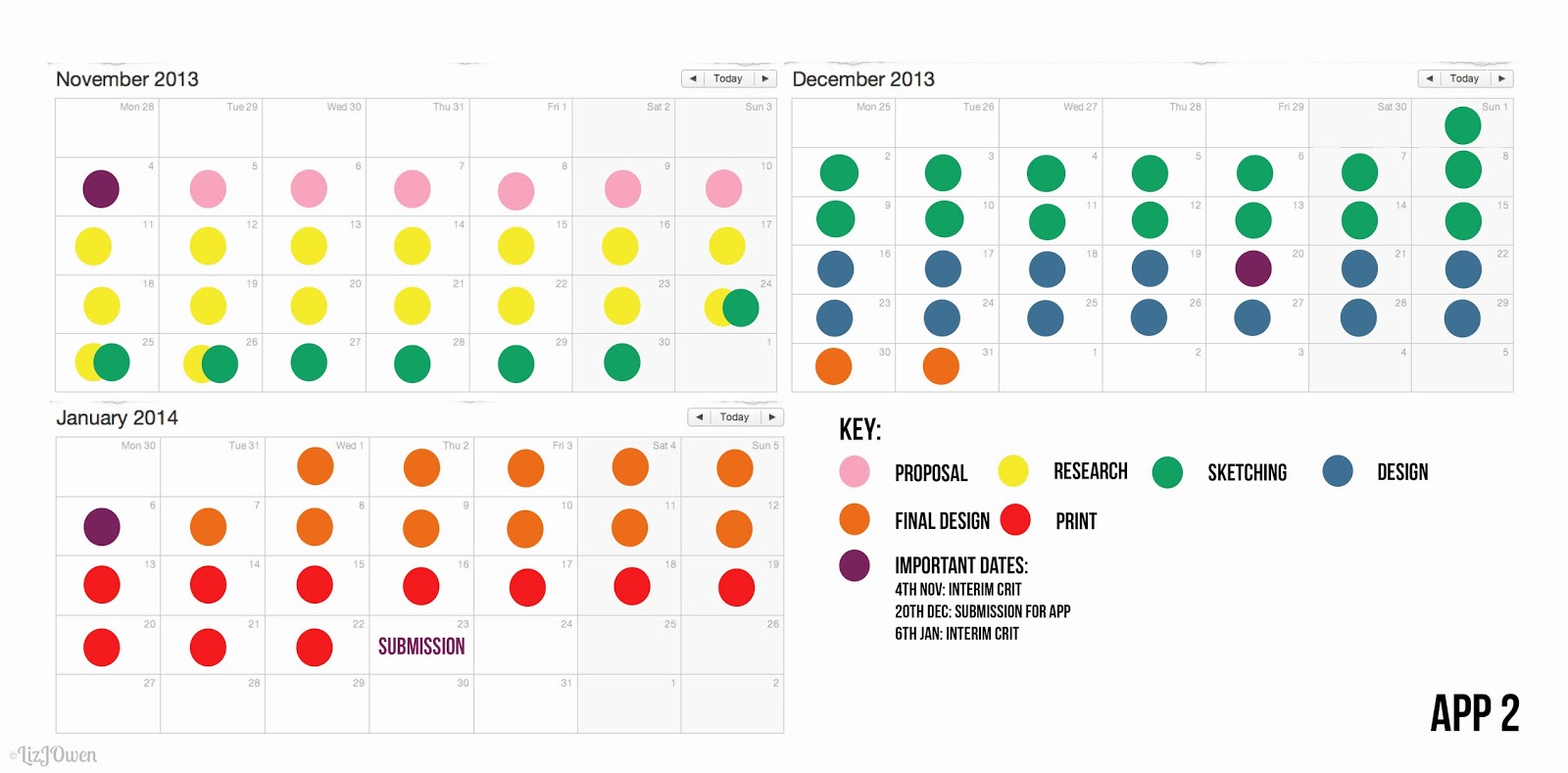
This is my updated version of my production schedule for this project:
I have seen some motivational quotes being hand lettered on posters, and so by creating it for a coffee mug I hope to make a fresh statement. I’ll probably come up with my own quote but in the meantime I’ll research into famous quotes.
As it’s going to be printed on a travel mug I must take printing costs into consideration, as it’ll be quite difficult to find a suitable company that would be able to print my design onto one. There is an option for me to print it onto a sticker sheet but then I would have to purchase this and take it to a printing company. Hopefully printing companies might be able to provide such sticker sheets!
Other costs that I would need to think about are those that cover the calligraphic materials I’ll be using for the hand lettering.
My target audience will be students, so throughout my project I could gather some feedback from my classmates – who are also interested in typography – because at the end of the day this product will be for them. I would thus need to please both them and the company that I’ll be ‘working’ for.
My pathway specialism is illustration, and with this project I hope to strengthen my illustrative techniques as well as combining it with typography, as I’m not too sure that I would want to work solely with illustration in future. Books such as ‘Hand Job’ will be really useful because they show examples of this integration of type and illustration.
I am going to handle this project – in terms of research and analysis – the same as my other APP, although in this case I’ll be looking at the work of professional typographers and those that are in that industry.
Overall Conclusion:
The crit helped me realise the importance of creating a client or target market as it stops you from straying too far off the project guidelines. It also makes my project brief a lot more realistic because I have someone that I need to impress with my product and it’s not vague like “I’m going to create a poster for someone who likes posters.”
I have also noticed that I’m not very experienced in hand lettering so my main focus on that project was to understand the basics of typography and to practice endlessly so that I could take it to a more professional status. If I am unable to do hand lettering then I’ll find ways to incorporate typography and illustration as my project brief doesn’t specifically say that I have to do the type by hand.

During my crit meeting with my lecturers and classmates I had written some notes on the feedback I had collected on my project proposals so that I may develop them further. I only showed them my two main APPs as I am more confident in my dissertation and feel that I could go for option C (the 7000 word dissertation and 2 APPs).
One of my lecturers produced a list to ensure that I have hit all of the points in creating a strong project proposal, so I’m going to “answer” some of these points here and use them to identify the objectives of my projects.
APP 1
For my first APP – which will be the illustration competition – will be aimed at the general public to portray the vibrant city of London. I shall be doing my poster design at A3 to submit as a university project, but the submission for the Serco Prize competition would be at one of the sizes they prefer. I can illustrate multiple stories within but would have to be colourful and eye-catching to the general public.
When I first got into illustration I had done some research into the key aspects of an illustrator, and one of them was personal style. Every illustrator has their own signature style, and throughout my years of being interested in art I have noticed that I concentrate mostly on biro and different line techniques that I then combine with watercolour. I’m hoping to develop this technique further by carrying out more experimentation so that I could get a firm hold on it, as it were.
I realised that my previous production schedule was flawed because it involved me handling all three projects (my 2 APPs and my dissertation) at once, so here I have designed three separate schedules so that I wouldn’t stress as much.
As the project involves creating a poster, the only costs I would have to worry about will be the printing of it as well as gathering materials. Luckily I have all the digital softwares that I might dabble with and recently. I have also recently obtained a Wacom Inkling that I’m bursting to try out!
Other people that would be involved in this project as well as those actually viewing it would be the hosts: Association of Illustrators and Serco. I am hoping to include elements of both parties (such as the London Underground or Red Bus) to represent the competition itself.
The Learning Outcomes, as I have said in a previous post, are quite broad which makes it all the more harder to be able to cover them. I have analysed each one here.
I haven’t heard of ‘professional practice’ before doing this project, but now I understand is that these APPs are projects to show how you are becoming a professional illustrator/designer/photographer as well as our knowledge on the subject. With this in mind I’m going to explore more into biro and watercolour (as mentioned above) as well as books on illustration to read up on how illustrators got to where they are now.
I’m also going to delve deeper into semiotics as each illustration – although accompanied with text – will be portraying a story, and I need to get the right ‘signs’ across. This could be included in my research on the fundamentals of illustration and I’ll be looking to see if there are any step-by-step processes of other illustrators.
At the end of each section of research I’ll be writing an analysis, which I’ve already started doing by writing conclusions at the end of each blog post. I’ll be constantly flicking back through my research, brief and mood boards to stay on the right track and it’ll perhaps show me new things to explore. The blog posts I’ve written so far are a bit vague and I need to write them in a more professional manner and look at reliable sources, not just Behance.net.
I fear that I have been dawdling for too long on my design brief, as my dissertation keeps distracting me. However writing this post and looking at my notes has made it a lot clearer to me on how to write a successful proposal.
APP 2
My client for this second project will be a tea company – possibly Twinings – so that I could create something to promote their company as well as being ‘motivational’ for stressful students like myself. I have noticed that more and more people tend to include drinking tea every time they take a break from doing lots of work, and that it relaxes them. This idea is strengthened by the presence of tea and cafes in the university.
I haven’t yet explored extensively into my second project although I have at least decided on my client and my target audience. It was a lot harder to figure out what to do with this project as it’s my own creation and I had to make sure that it links my interests and my pathway specialism (illustration), although I worry slightly of my lack of experience in hand lettering. To overcome this, I’ll do extensive research on it and practice at least a little bit every day so that I could get the hang of it.
This is my updated version of my production schedule for this project:
I have seen some motivational quotes being hand lettered on posters, and so by creating it for a coffee mug I hope to make a fresh statement. I’ll probably come up with my own quote but in the meantime I’ll research into famous quotes.
As it’s going to be printed on a travel mug I must take printing costs into consideration, as it’ll be quite difficult to find a suitable company that would be able to print my design onto one. There is an option for me to print it onto a sticker sheet but then I would have to purchase this and take it to a printing company. Hopefully printing companies might be able to provide such sticker sheets!
Other costs that I would need to think about are those that cover the calligraphic materials I’ll be using for the hand lettering.
My target audience will be students, so throughout my project I could gather some feedback from my classmates – who are also interested in typography – because at the end of the day this product will be for them. I would thus need to please both them and the company that I’ll be ‘working’ for.
My pathway specialism is illustration, and with this project I hope to strengthen my illustrative techniques as well as combining it with typography, as I’m not too sure that I would want to work solely with illustration in future. Books such as ‘Hand Job’ will be really useful because they show examples of this integration of type and illustration.
I am going to handle this project – in terms of research and analysis – the same as my other APP, although in this case I’ll be looking at the work of professional typographers and those that are in that industry.
Overall Conclusion:
The crit helped me realise the importance of creating a client or target market as it stops you from straying too far off the project guidelines. It also makes my project brief a lot more realistic because I have someone that I need to impress with my product and it’s not vague like “I’m going to create a poster for someone who likes posters.”
I have also noticed that I’m not very experienced in hand lettering so my main focus on that project was to understand the basics of typography and to practice endlessly so that I could take it to a more professional status. If I am unable to do hand lettering then I’ll find ways to incorporate typography and illustration as my project brief doesn’t specifically say that I have to do the type by hand.
Tuesday, 8 October 2013
APP: Possible Ideas Contin.
It has been a few days since I was given my APP brief, and during that time I have been thinking over my interests and generated some possible ideas with the help of mind maps. Yet I feel that I need to delve deeper in other to create a strong and successful design briefs.
I'm going to aim to produce three briefs as I haven't yet provided a sufficient amount of research for my dissertation, and if I do happen to fall on Option B then at least I already have an extra brief "waiting" for me.
Typography
I haven't done any hand lettering yet but I have a deep interest in them. If I happen to choose to do typography or hand lettering for a brief then I might find it challenging, and yet this will also mean that I could tick off another thing on my personal to-do list.
Here's a mood board of inspirations:
Image sources: Greg Coulton: http://www.behance.net/gregcoulton; Martin Schmetzer: http://www.behance.net/PapperOPenna; Sagmeister & Walsh and Yuko Shimizu: http://www.behance.net/gallery/Yes-Dumbo-Improvement-Project-Mural/11245521; Steve Simpson: http://www.behance.net/stevesimpson (2) ; Antonia Rodrigues Jr: http://www.behance.net/ARJr; Pako Garcia: http://www.behance.net/hideer; Alison Freund: http://www.behance.net/allisonfreund; Biljana Kroll: http://www.behance.net/biljanakroll; Linzie Hunter: http://www.behance.net/Linzie; Kelly Thorn: http://www.kellythorn.com/
From looking at this mood board I am inspired to mix illustration with typography, and perhaps do something like inspirational quotes on little cards, diaries or even a little coffee cup.
Birthday Card
One of my other ideas was to produce a birthday card but I'm not too sure what target market to aim for. I would like to do something for those in their late twenties and up as I realised that it's quite hard for them to buy cards for others (especially because most cards are all sparkly and pretty). However I just need some inspiration!
I'm going to aim to produce three briefs as I haven't yet provided a sufficient amount of research for my dissertation, and if I do happen to fall on Option B then at least I already have an extra brief "waiting" for me.
Typography
I haven't done any hand lettering yet but I have a deep interest in them. If I happen to choose to do typography or hand lettering for a brief then I might find it challenging, and yet this will also mean that I could tick off another thing on my personal to-do list.
Here's a mood board of inspirations:
Image sources: Greg Coulton: http://www.behance.net/gregcoulton; Martin Schmetzer: http://www.behance.net/PapperOPenna; Sagmeister & Walsh and Yuko Shimizu: http://www.behance.net/gallery/Yes-Dumbo-Improvement-Project-Mural/11245521; Steve Simpson: http://www.behance.net/stevesimpson (2) ; Antonia Rodrigues Jr: http://www.behance.net/ARJr; Pako Garcia: http://www.behance.net/hideer; Alison Freund: http://www.behance.net/allisonfreund; Biljana Kroll: http://www.behance.net/biljanakroll; Linzie Hunter: http://www.behance.net/Linzie; Kelly Thorn: http://www.kellythorn.com/
From looking at this mood board I am inspired to mix illustration with typography, and perhaps do something like inspirational quotes on little cards, diaries or even a little coffee cup.
Birthday Card
One of my other ideas was to produce a birthday card but I'm not too sure what target market to aim for. I would like to do something for those in their late twenties and up as I realised that it's quite hard for them to buy cards for others (especially because most cards are all sparkly and pretty). However I just need some inspiration!
Labels:
APP,
APP AOI,
APP Home,
APP Identity,
APP Words,
inspiration,
research
Sunday, 6 October 2013
V&A Exhibitions: The Memory Palace and Illustration Awards
On Monday my design group and I went to visit the V&A Museum to see a few exhibitions: the Memory Palace, V&A Illustration Awards and the Making It Up: Photographic Fictions.
I found all of them quite interesting but the one that was the most unusual was the Memory Palace. It was set out as a “walk-through book” which was something I haven’t heard of nor experienced before so I was quite excited to see it again as I went there previously with a friend over the summer.
The Memory Palace
I have to admit that I much enjoyed the second trip compared to the first as I was a bit overwhelmed by how strange it was, but now I was able to think deeper and analyse some of the pieces there.
The “walk-through book” was actually much easier to follow than it is in a normal book, as every part is sectioned off with plenty of illustrations and typography. The text wasn’t displayed in blocks of texts but broken up into two or three sentences. This created a sense of flow because it allows the viewer to take their time when going around the room and follow the story at their own pace, allowing them to take all of the information in rather than glazing over a large amount of information.
However it was quite difficult to follow exactly where to go next because of the fact that this “book” is spread across various walls, but somehow everything is still flowed perfectly as the mind will then take the pieces of information they have gathered and connect them. This means that it might be easier to read this “book” as an actual book, because it’s clear what to read next.
Francesco Franchi
As the “walk-through book” covered a whole room, it meant that everything was larger so that all of the little details could be seen up close. An example of this is the first illustration done by Francesco Franchi, which was an infographic poster on the art of mnemonics (an aid in remembering).
The poster itself is extremely large, much larger than A1 and is set out in a portrait orientation with the timeline at the side. This means that the viewer is able to see the type clearly, even the smallest one. It is quite hard to follow the type due to the poster’s incredible detail, which is probably why the designers had used a monotone palette as a colourful one would only confuse the viewer and all of that detail would be lost.
Both of the typefaces they used were sans serif, meaning that it was easier to read as there weren’t any little serifs to get in the way when they’re at a small scale. The one used for the heading has a digital/sci-fi appearance – much like the ones used in digital clocks – which could relate to the technology that had been lost in this future world. The other typeface is quite plain and this might suggest that people have forgotten what printed words looked like and so used its simplest form.
This means that at first the poster is quite overwhelming because there is a lot of type, little illustrations and symbols to read. However the way it’s been displayed allows the viewer to take each part by circle before moving onto the next one. The eyes flow accordingly to how everything is placed: from the silhouette of a head at the bottom, then across all of the circles that are connected by thin lines.
These lines could bring up connotations of sunrays or the solar system, as a series of circles are connected to such lines. This thus is connected to science which and supports the whole subject of this infographic as it’s showing the art of mnemonics.
The combination of these “sun rays” and circles bring up the overall image of cogs, so might suggest that the human mind is similar to that of a clock, as when time goes by our minds expand to take in more knowledge.
I found all of them quite interesting but the one that was the most unusual was the Memory Palace. It was set out as a “walk-through book” which was something I haven’t heard of nor experienced before so I was quite excited to see it again as I went there previously with a friend over the summer.
The Memory Palace
I have to admit that I much enjoyed the second trip compared to the first as I was a bit overwhelmed by how strange it was, but now I was able to think deeper and analyse some of the pieces there.
The “walk-through book” was actually much easier to follow than it is in a normal book, as every part is sectioned off with plenty of illustrations and typography. The text wasn’t displayed in blocks of texts but broken up into two or three sentences. This created a sense of flow because it allows the viewer to take their time when going around the room and follow the story at their own pace, allowing them to take all of the information in rather than glazing over a large amount of information.
However it was quite difficult to follow exactly where to go next because of the fact that this “book” is spread across various walls, but somehow everything is still flowed perfectly as the mind will then take the pieces of information they have gathered and connect them. This means that it might be easier to read this “book” as an actual book, because it’s clear what to read next.
Francesco Franchi
As the “walk-through book” covered a whole room, it meant that everything was larger so that all of the little details could be seen up close. An example of this is the first illustration done by Francesco Franchi, which was an infographic poster on the art of mnemonics (an aid in remembering).
The poster itself is extremely large, much larger than A1 and is set out in a portrait orientation with the timeline at the side. This means that the viewer is able to see the type clearly, even the smallest one. It is quite hard to follow the type due to the poster’s incredible detail, which is probably why the designers had used a monotone palette as a colourful one would only confuse the viewer and all of that detail would be lost.
Both of the typefaces they used were sans serif, meaning that it was easier to read as there weren’t any little serifs to get in the way when they’re at a small scale. The one used for the heading has a digital/sci-fi appearance – much like the ones used in digital clocks – which could relate to the technology that had been lost in this future world. The other typeface is quite plain and this might suggest that people have forgotten what printed words looked like and so used its simplest form.
This means that at first the poster is quite overwhelming because there is a lot of type, little illustrations and symbols to read. However the way it’s been displayed allows the viewer to take each part by circle before moving onto the next one. The eyes flow accordingly to how everything is placed: from the silhouette of a head at the bottom, then across all of the circles that are connected by thin lines.
These lines could bring up connotations of sunrays or the solar system, as a series of circles are connected to such lines. This thus is connected to science which and supports the whole subject of this infographic as it’s showing the art of mnemonics.
The combination of these “sun rays” and circles bring up the overall image of cogs, so might suggest that the human mind is similar to that of a clock, as when time goes by our minds expand to take in more knowledge.
Labels:
APP,
APP AOI,
APP Home,
APP Identity,
APP Words,
inspiration,
research
Friday, 4 October 2013
APP: The Overall Brief and Learning Outcomes Analysis
Project: Advanced Professional Practice
Level: Honours
Date Set: 30.09.2013
Date Due: Part 1: 16.12.13 and full submission 23.01.14
Preamble
This module is designed to encourage and enable students to use graphic design and the 'client' to expand and develop their professional style and to produce bodies of work for public scrutiny and evaluation. The module will enable students to synthesise theoretical, conceptual and technical skills gained during the programme to manage projects in a variety of areas of design practice and produce appropriate practical solutions.
The brief is designed in such a way as to allow open interpretation within the given theme and allow flexibility within chosen pathways. To ensure clear direction and intent from the outset of the course, you will need to determine and agree with the teach staff, your chosen pathway, i.e. typography, illustration, etc.
The Brief
The 'weight' of the dissertation that you have chosen will determine how many of the themes you will have to cover. The following indicates how many themes you are to choose:
Title
Pathway Option A -
Dissertation - 15 credits (3000-4000 words)
Advance Professional Practice - 60 credits (4 projects)
Major Project - 45 credits
Pathway Option B
Dissertation - 30 credits (5000-6000 words)
Advanced Professional Practice - 45 credits (3 themes)
Major Project - 45 credits
Pathway Option C
Dissertation - 45 credits (7000-8000 words)
Advanced Professional Practice - 30 credits (2 themes)
Major Project - 45 credits
Choose theme(s) from the following:
Arrival
Identity
Words
Conflict
Adventure
Home
Conclusion:
With all of this in mind, I will now need to decide which of the themes to choose which I shall do by creating mind maps of each one. Luckily the brief is allows for open interpretation so that I could create something that I'm interested in.
Learning Outcomes
Here are the learning outcomes for the APP, and I have analysed each one just beneath it.
[1] Gain an understanding of the needs and requirements of professional practice.
I am doing this by analysing the design brief and learning outcomes so that I aim to meet each point made. I know that it might be impossible to cover absolutely everything but I shall try my best! I would also like to look at existing products to see how other designers tackled similar briefs.
[2] Develop effective communication skills through the medium of [specialist] graphic design.
This is quite new to me as I haven't had this learning outcome before, so I'm assuming what they mean by "effective communication skills" is asking for feedback from both my classmates and the public and to write them down so that I can show how they have helped me through my designing process.
Level: Honours
Date Set: 30.09.2013
Date Due: Part 1: 16.12.13 and full submission 23.01.14
Preamble
This module is designed to encourage and enable students to use graphic design and the 'client' to expand and develop their professional style and to produce bodies of work for public scrutiny and evaluation. The module will enable students to synthesise theoretical, conceptual and technical skills gained during the programme to manage projects in a variety of areas of design practice and produce appropriate practical solutions.
The brief is designed in such a way as to allow open interpretation within the given theme and allow flexibility within chosen pathways. To ensure clear direction and intent from the outset of the course, you will need to determine and agree with the teach staff, your chosen pathway, i.e. typography, illustration, etc.
The Brief
The 'weight' of the dissertation that you have chosen will determine how many of the themes you will have to cover. The following indicates how many themes you are to choose:
Title
Pathway Option A -
Dissertation - 15 credits (3000-4000 words)
Advance Professional Practice - 60 credits (4 projects)
Major Project - 45 credits
Pathway Option B
Dissertation - 30 credits (5000-6000 words)
Advanced Professional Practice - 45 credits (3 themes)
Major Project - 45 credits
Pathway Option C
Dissertation - 45 credits (7000-8000 words)
Advanced Professional Practice - 30 credits (2 themes)
Major Project - 45 credits
Choose theme(s) from the following:
Arrival
Identity
Words
Conflict
Adventure
Home
Conclusion:
With all of this in mind, I will now need to decide which of the themes to choose which I shall do by creating mind maps of each one. Luckily the brief is allows for open interpretation so that I could create something that I'm interested in.
Learning Outcomes
Here are the learning outcomes for the APP, and I have analysed each one just beneath it.
[1] Gain an understanding of the needs and requirements of professional practice.
I am doing this by analysing the design brief and learning outcomes so that I aim to meet each point made. I know that it might be impossible to cover absolutely everything but I shall try my best! I would also like to look at existing products to see how other designers tackled similar briefs.
[2] Develop effective communication skills through the medium of [specialist] graphic design.
This is quite new to me as I haven't had this learning outcome before, so I'm assuming what they mean by "effective communication skills" is asking for feedback from both my classmates and the public and to write them down so that I can show how they have helped me through my designing process.
Tuesday, 1 October 2013
Dissertation And APP Timetable
I have created a timetable to help me juggle all of these projects at once, as it was extremely helpful to me last year when I was working on my FMP alongside my Portraits project.
Subscribe to:
Posts (Atom)